


Team development works, in the right format
Most organisations have tried to improve teamwork by teaching people about it. A session, a model, some slides on communication styles. Attendance is good, feedback is polite, and nothing observable changes.
The natural conclusion is that team development doesn't work. A 2017 meta-analysis supports a different one: that particular format doesn't work, and three others do.
Why this study carries more weight than most
Desmond McEwan, Geralyn Ruissen, Mark Eys, Bruno Zumbo and Mark Beauchamp published in PLOS ONE a systematic review and meta-analysis restricted to controlled interventions — studies with a control group, so you can attribute change to the intervention rather than to time passing.
That restriction matters. This is the closest the literature comes to asking: if we do this to a team, does it get better than a comparable team we didn't?
They included 51 articles, 72 unique interventions, 8,439 participants — 4,966 in experimental conditions, 3,473 controls.
The headline
Teamwork behaviours improved substantially. Team performance improved by more again.
The authors' conclusion, verbatim: teamwork training is an effective way to foster teamwork and team performance. These effects appear evident across numerous intervention methods.
The breakdown that explains the failed course
Not all methods performed equally.
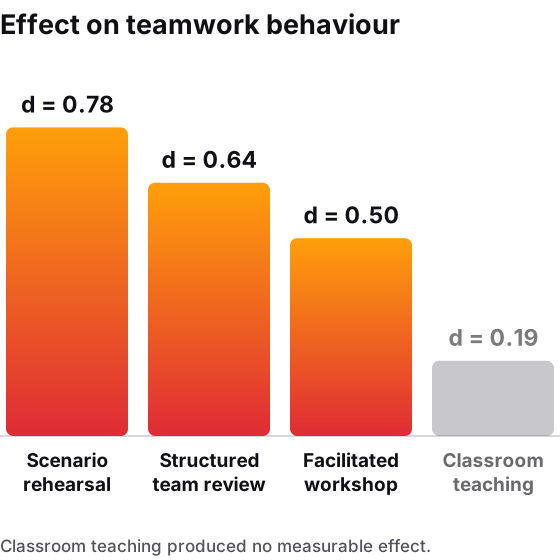
Scenario rehearsal (simulation-based): the largest effect of the four
Structured team review: close behind it
Facilitated workshop: moderate
Classroom teaching (didactic): no measurable effect at all
Didactic education — teaching people about teamwork in the way you'd teach a topic — did not shift teamwork behaviours.
Every method that did work has one thing in common: the team does something together and then examines it. Rehearsing a scenario. Reviewing how a piece of work went. Working through something in a facilitated session. The learning happens in the team, about the team, rather than being delivered to individuals who happen to be sitting near each other.
The finding for anyone with an existing team
Newly formed teams and intact teams both improved, but differently. Newly formed teams showed the larger gains in teamwork behaviours. Intact teams showed much larger gains in performance — roughly double.
That's the opposite of what people often assume. The teams that benefit most on performance aren't the fresh ones you can shape from scratch. They're the ones already running, with history and habits, where a shift in how they work has somewhere to land.
Where TeamHive sits in this
The best-performing formats are the reason TeamHive 360 works the way it does. A 360 plus a structured debrief is a structured team review — a team examining, with measured data rather than impressions, how it actually works.
TeamHive 360 is built for teams that already exist — with history, habits, and somewhere for a shift to land — because that's where the controlled evidence says the performance gains are largest.


