

"We've done team building" is usually where the conversation should start
When I suggest to a leadership team that they spend some time working on how they work together, I quite often get told, very politely, that they've done team building already. They had a day out last year. There was a facilitator, a few exercises, maybe an escape room. Everyone had a good time.
Then I ask what's different now, and there's usually a pause.
I don't think they're wrong that it didn't do much. I just don't think what they did is what I'm suggesting. So I was really pleased to come across a paper that sets out the difference properly, because it's something I've always struggled to explain in a sentence.
What they looked at
Rebecca Jones, Uwe Napiersky and Joanne Lyubovnikova, writing in the Journal of Managerial Psychology, started from a pretty honest admission. Nobody had clearly pinned down what team coaching is, or where it ends and team training, team building and team development begin. Team coaching has been growing fast, and the research hadn't caught up with what practitioners were actually doing.
So they asked the practitioners. They surveyed 410 people who deliver team coaching, asked how they'd define it and how they'd tell it apart from the other options, and turned the answers into a definition and a simple way of sorting all four.
The four, in plain terms
Here's roughly how they sort them (my words, their categories):
Team training teaches a team something it needs for the task: a new tool, process or method. Think of a hospital team learning a new triage process.
Team development is informal and short, usually early in a team's life, to help people get to know and trust each other. Their examples are orienteering, treasure hunts, tower building and escape rooms.
Team building is more formal but still short-term. A session to agree a team charter, say, or to go through the results of a team assessment together.
Team coaching works on how the team works together, over a series of sessions rather than one. The coach asks questions and helps the team reflect. They don't hand over advice or solutions.
Two things surprised me. The first is that the ropes course, the thing most of us picture when we hear "team building", is actually a team activity in their terms. The second is how close team building and team coaching are on paper. Both are formal, both focus on teamwork, and both are aimed at the team's goals and performance. What separates them is time, and how the coach works with the team.
The example that stuck with me
The paper describes a senior team where people don't really talk about the important issues in meetings. The conversation stays polite and on task, and the real conversations happen afterwards, in the hallways and behind closed doors.
I've worked with more senior teams like that than I could count. And the authors are quite blunt about why a one-off won't fix it. Training won't touch it, because it isn't a skills problem. A fun day out won't get anywhere near it. Even a well-run single session doesn't give the team long enough to properly look at what's going on and work out what's really causing it. It takes time with a coach, over a number of sessions, before those hallway conversations start happening in the room. (That's most of what we mean by Unity in the PLUS model.)
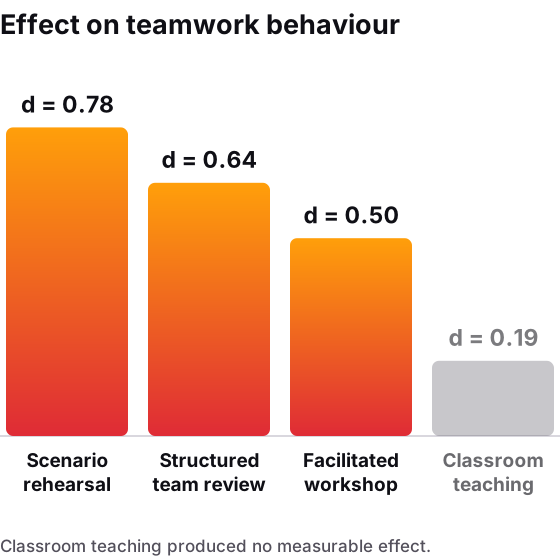
It matches what I saw years ago in an organisation where we ran four kinds of development side by side. All four worked, but team coaching made by far the biggest difference to how people behaved over the long run.
Why the labels matter
Partly it's about being fair to the evidence. If a team's only experience of "team stuff" is an afternoon of activities, they've judged the whole category on one example. And to be fair to the afternoon, it probably did some good. A large review of team building studies found it has a real, moderate effect, mostly on how people feel about the team and how they work together.
But when you look across the research on how teams improve for the formats with the strongest results, a pattern shows up. In a review of controlled teamwork interventions, the approach with the biggest effect on team performance was teams reviewing their own work while they did it, rather than learning about teamwork somewhere else. A separate review of debriefs found that teams who stop and look honestly at how they actually performed get substantially better, especially when someone facilitates it. And a long-running program of field studies on team measurement and feedback found that when teams measured how they were going and got regular feedback on it, the gains were large and lasted, in some cases for years.
Put those together and it isn't really about whether the day out was a good day. The strongest results come from a team looking at real information about itself, again and again, and working on what it finds. That's what team coaching does, and it's very hard to do in a day.
And partly it's practical. If you're an HR leader or an executive deciding what to fund, it's worth asking which of the four you're actually being offered. A charter workshop, an off-site and an ongoing coaching engagement can all end up on the same budget line, and they don't do the same job. Most organisations already put far more into developing individuals than developing teams, so it matters that the team money goes to the right thing.
Where TeamHive fits
I'll be honest about this one. Going through the results of a team diagnostic once, even ours, would count as team building by the paper's definition. It's a useful start, but it isn't where the lasting change happens.
That's why the TeamHive 360 is built for teams to keep coming back to. The team sees how it's working across the four areas of the PLUS model, from the inside and from the people around it. It works on what it finds, with the HiveAI Coach to help between sessions, and then re-tests with a Pulse to see whether things are actually shifting. For coaches, it means getting to the real issue faster, and having something to measure progress against across the engagement.
If you'd like a feel for where your own team sits, the Free Team Effectiveness Indicator takes under ten minutes. And if you missed it, last week's piece on shared leadership is a good companion to this one.