

Seven things I've learned about how teams actually get better
A few weeks ago we wrapped up Teams Matter, a series making the case that teams matter more than most organisations act like they do. The question I got most often afterwards was a fair one: fine, but can you actually make a team better? And how?
So we spent the next six articles on exactly that. A meta-analysis of controlled team interventions. The Brumbies, and 2,650 teams that got better without changing who was on them. Leadership development's own evidence. A study tracing how shared leadership actually pays off. The difference between team coaching and team building. And our own pilot, the one that became TeamHive.
Here's the short version. Some of it comes from the papers, some from rooms I've sat in. The two agree more often than I expected.
1. If the team course didn't work, look at the format before you give up on the idea.
"We sent everyone on the course and nothing changed." I hear this almost every week, usually as the reason team development isn't worth trying again.
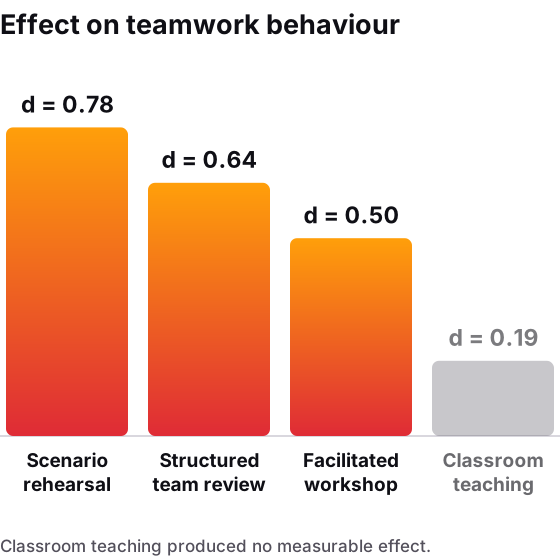
Desmond McEwan and colleagues pooled only controlled studies — interventions with a comparison group — across 51 studies and more than eight thousand people. Team development worked: teamwork behaviours improved, and team performance improved by more again. But not every format. Rehearsing real scenarios worked best, structured team review close behind, facilitated workshops moderately. Classroom teaching about teamwork had no measurable effect at all.
Teaching people about teamwork did nothing. Getting a team to work on itself did. If your last attempt was slides in a room, the evidence says that was predictably ineffective, and it tells you nothing about the alternative.
2. The teams you already have are the ones with the most to gain.
The same meta-analysis found something I didn't expect. Newly formed teams picked up new behaviours fastest, but intact teams — real teams, already working together — showed roughly double the gains in performance.
That matches what I see. A team with history and habits has somewhere for a change to land. Nothing about it needs a new team. It needs the existing one to look at itself.
3. You can improve a team without changing who's on it.
When Super 12 started in 1996, the ACT Brumbies were assembled largely from players other states hadn't wanted. Rod Macqueen didn't go looking for better players. He trained the team he had, as a team, until they could run four or five phases deep without being told. They reached the final in their second season.
Eduardo Salas and colleagues asked whether that generalises, across research covering around 2,650 teams. It does. Training a team as a team improved how it coordinated, how it thought together, what it produced and how it felt about itself. Most leaders I work with can't rebuild their team. This is the evidence that they don't need to.
4. Leadership development works too. The answer is both, not one.
I spend a lot of time arguing that organisations under-invest in teams, and it would be easy to hear that as an argument against developing leaders. It isn't. Christina Lacerenza and colleagues meta-analysed leadership training across 335 samples and found it substantially more effective than previously thought, including in the behaviour people carried back into the job.
So the honest position is an AND. Both layers work. The mistake isn't developing leaders; it's developing only leaders. In our own validation work with the University of Newcastle, the team-level PLUS dimensions explained differences in team effectiveness beyond two established leadership instruments. Different layer, different information. And both literatures land on the same lesson about method: practice, feedback and review beat anything delivered passively.
5. "You're all empowered now" doesn't work. Here's why.
I've watched a leader announce that the team is empowered, step back and wait. What arrives is usually confusion and a decision nobody makes for three weeks.
Christopher Porter and colleagues followed 85 teams to see how shared leadership actually pays off, and found a chain. Sharing leadership built the team's shared belief that it could do the job. That belief showed up as behaviour — monitoring progress, backing each other up, coordinating rather than assuming. And that behaviour is what lifted performance and helped the teams learn faster. Hand over authority without the belief shifting, and the chain breaks at the first link. Nothing downstream happens. It's also the half of leadership most organisations never measure.
6. Team coaching isn't team building, and the ropes course isn't either.
"We've done team building." Ask what they did and it's usually a day out: a facilitator, an escape room, maybe a ropes course.
Rebecca Jones and colleagues asked 410 team coaching practitioners where the lines actually sit. The day out turns out to be a team activity in their terms: informal, short, and mostly about getting to know each other. Team building is a formal one-off session, like agreeing a team charter. Team coaching works on the same things, but over a series of sessions, with a coach who helps the team reflect rather than handing over answers.
Team days do help. A large review of team building studies found a real, moderate effect. But the strongest results in the research come from teams regularly looking at real information about how they're working and acting on it, and that's very hard to do in a day. A leadership team whose only experience is the day out hasn't tried the other thing yet.
7. Every development approach worked. The team-level one stuck.
Years ago we ran a pilot inside an Australian financial services company, alongside an organisation-wide culture programme, comparing four kinds of development: leadership workshops, peer coaching, individual coaching and team coaching. All four worked. I always say that first, because it's true. But team coaching had by far the largest impact on long-term behaviour change, for the individuals as well as the teams.
It left two problems. It couldn't reach past the top team, and leaders were deciding on impressions rather than data. What we noticed was that teams moved fastest once they'd seen their own reality clearly. I can't count the sessions I've spent with a team convinced role clarity was their problem, only to work through it and find nothing else had moved. Once a team can see where to look, it moves. That's the question TeamHive 360 was built to answer.
So that's my seven. None of it says teams improve on their own. It says they improve when they work on themselves, together, on the real thing. The research just tells you which formats let them.
The six How Teams Improve articles are on the TeamHive blog, and if you want the long read, our white paper Teams can be improved. Not by every method. brings them together. If you're curious where your own team would start, the Free Team Effectiveness Indicator takes under ten minutes. No strings attached.