

What a team does when it can't buy better players
When Super Rugby launched in 1996, Australian rugby had two established powers and a brand-new third franchise in Canberra - “The Brumbies”. They were assembled largely from players New South Wales and Queensland hadn't wanted — 'the misfits and rejects', a label the squad wore with some pride.
Coach Rod Macqueen recruited by ringing people up and asking whether they wanted to be part of it. The foundation captain paused his medical studies to come. One of the forwards was an electrician who took leave without pay.
They finished fifth in their first season. In their second they reached the Super Rugby Grand Final. Shortly after that they won two Super Rugby titles.
What they had instead of talent
The Brumbies didn’t have better players. They had a way of working together that they had practised until it was automatic.
Macqueen built the side around structured, rehearsed patterns of play — sequences the team ran together, phase after phase, so each player knew the next three or four moves without being told. Joe Roff later described knowing the patterns four or five phases ahead.
That is team training in the most literal sense: deliberate, repeated practice done by the whole group, together, aimed at how the group performs. And the method outlasted the squad — Macqueen took it to the Wallabies, and to the 1999 World Cup.
Does it generalise?
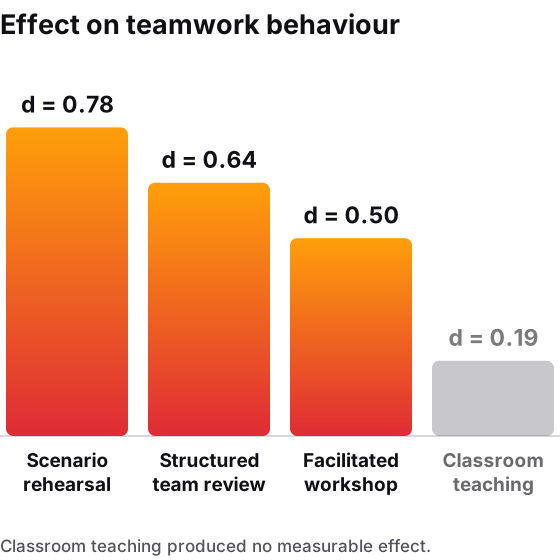
One rugby team is a story, but there is actually a lot of evidence for this effect. In 2008, Eduardo Salas and colleagues published a meta-analysis in Human Factors asking whether training a team — as a team — improves how it performs. Their database covered 2,650 teams — military crews, aviation and medical teams, and teams assembled in the lab.
The answer was yes, and it was yes everywhere they looked. Every category of outcome improved:
Team processes — how the team coordinates
Cognitive — the shared understanding the team holds
Performance — what the team actually produces
Affective — confidence in each other, cohesion
Two notes on the story that make it more useful
The 1996 misfits did not win immediately. They lost the 1997 final 23–7, and the first title came in 2001 — by which time the system had produced genuine stars in George Gregan, Stephen Larkham and Joe Roff. The sequence matters: it wasn't stars who created the way of working; it was the way of working that grew the players.
Team development is slow, it compounds, and individual capability turns out to be partly a by-product.
What to take from it
If your team can't be reassembled — and most can't — this is the evidence that the remaining lever is real. Training the team you have is not a consolation prize for organisations that can't hire. Across a large body of research it makes teams measurably better at coordinating, thinking, performing and holding together.
Most workplaces can't run four hundred repetitions of a set play. But the thing underneath the Brumbies' drills — a team building a shared, accurate picture of how it operates, and deliberately working on that — is available to any intact team. That's what a TeamHive 360 and its debrief are: the shared picture, measured, so the deliberate work has something to aim at.